Artforms

Past the gates of Kerala Kalamandalam, its soul unfolds through its diverse spaces. The Kalari, the Kuttampalam, the museum, and the library.

Kathakali

Long before silver screens and larger-than-life figures stirred the imagination, it was Kathakali, performed through the night under oil-lit lamps in village grounds, that transported Kerala’s....

MORE

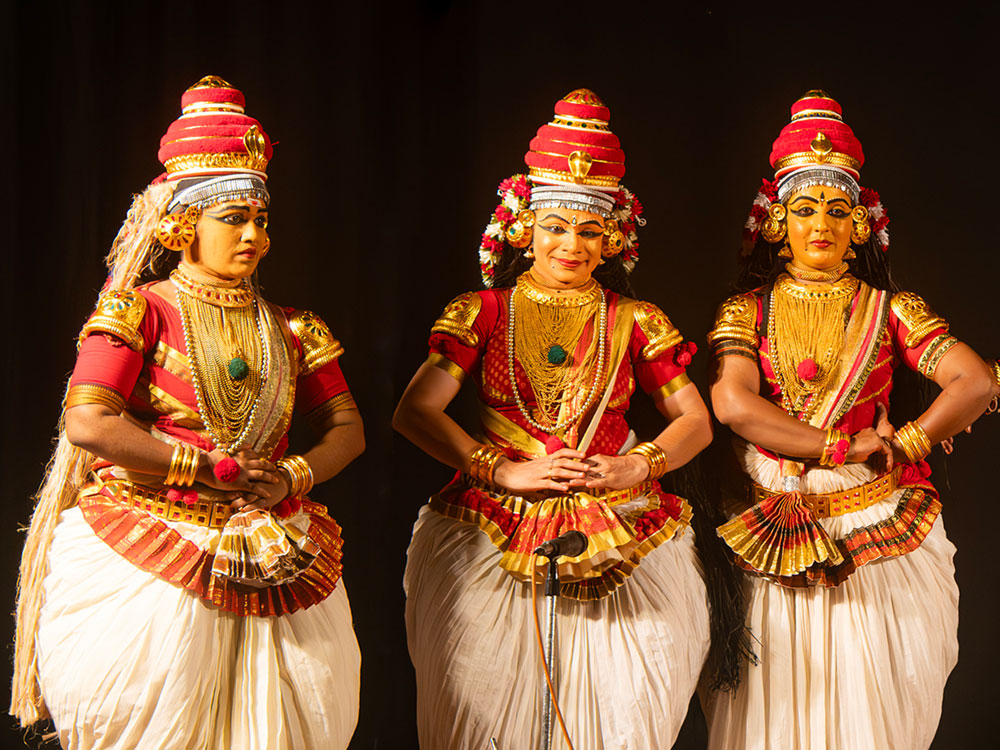
Kathakali

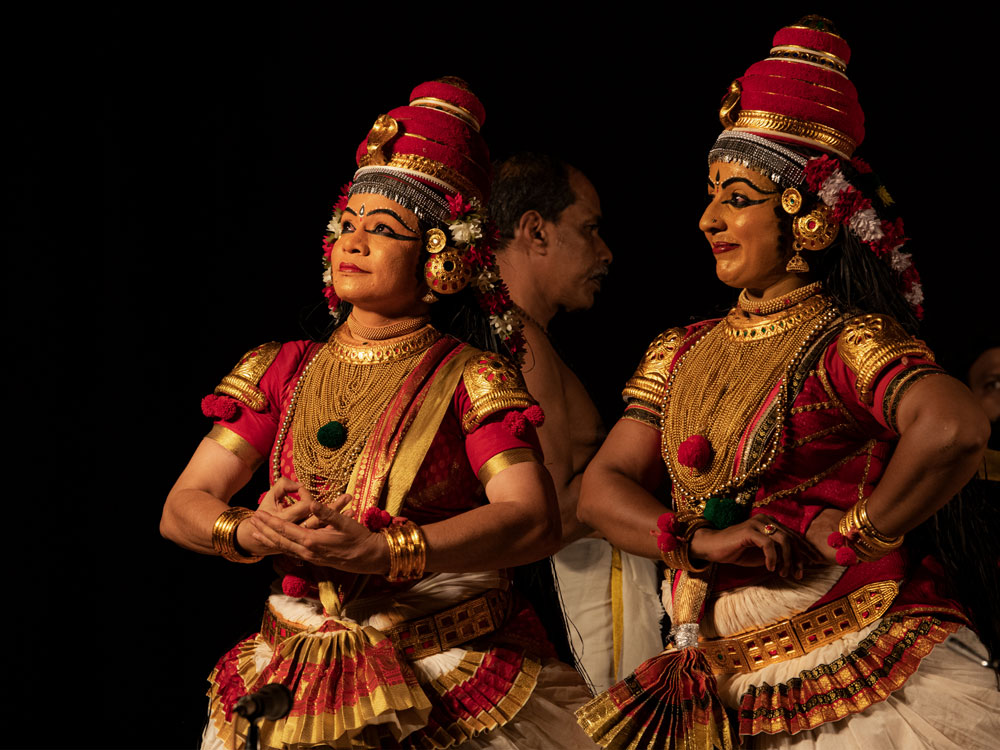
Long before silver screens and larger-than-life figures stirred the imagination, it was Kathakali, performed through the night under oil-lit lamps in village grounds, that transported Kerala’s people into worlds of gods, warriors, and cosmic battles. Drawn from the epics of the Ramayana and Mahabharata, this ‘story-play’ is marked by the haunting intensity of expression, hand gestures, footwork, and hypnotic music, creating an unforgettable experience of total theatre.

Rooted in the 17th century, Kathakali is a grand confluence of Kerala’s classical, folk, and ritual traditions. Its towering headgear, billowing skirts, and painted faces draw from forms like Theyyam, Mudiyettu, and Kalamezhuthu. Its acting tradition stems from Kutiyattam, India’s oldest living Sanskrit theatre, while its movement vocabulary is chiselled from Kalaripayattu, Kerala’s indigenous martial art. The soundscape is no less rich—a fusion of Sopana Sangeetham, Kerala’s temple music tradition, and the classical elegance of Carnatic music, carried by a powerful orchestra of voice, chenda, maddalam, and cymbals.

To learn Kathakali is to step into a world of physical mastery, expressive nuance, and spiritual discipline. Auxiliary courses in music, percussion, and make-up are integral to the training, offering students a holistic understanding of this complex art form.
Kutiyattam

The oldest surviving Sanskrit theatre, Kutiyattam, was conceived not for the entertainment of the masses. It took shape as a sacred ritual, performed within incense-swirled....

MORE

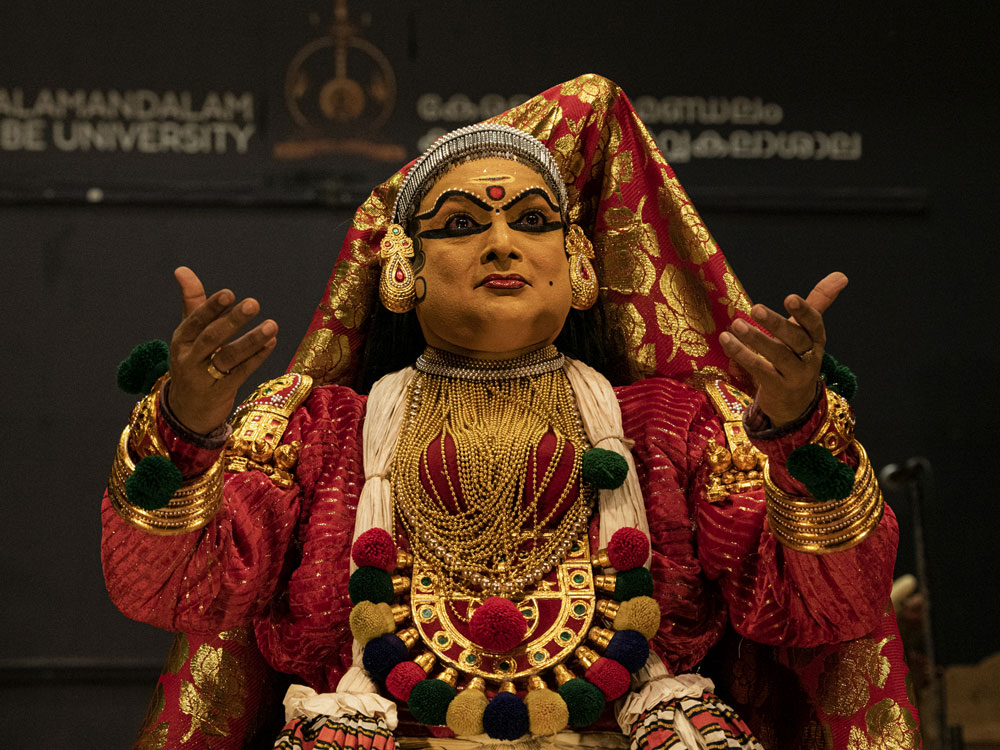
Kutiyattam

The oldest surviving Sanskrit theatre, Kutiyattam, was conceived not for the entertainment of the masses. It took shape as a sacred ritual, performed within incense-swirled temple theatres where art became an offering to the divine. Staged only in the temple theatres known as Koothambalams, this classical Sanskrit drama was an art form reserved for performance by the Chakyar and Nambiar communities, with its scripts drawn from the grand Sanskrit repertoire. Over time, bound by caste and cloistered by exclusivity, this ancient tradition edged toward extinction.

Change, however, came in the mid-20th century. Kutiyattam stepped out of temple walls, its gestures and gazes no longer bound by gate or tradition, reaching new audiences through public performances and institutions like Kerala Kalamandalam. A turning point came in 1965, when Painkulam Rama Chakyar, the visionary who first dared to perform Kutiyattam outside the temple, joined Kalamandalam. Under his guidance, the art form nurtured a new generation of performers, breaking free from centuries of constraint. In 2001, its historical and performative value was globally recognised when UNESCO declared Kutiyattam an ‘Intangible Cultural Heritage of Humanity.’

Kutiyattam is, at its core, an actor’s theatre. With the eyes and hands as primary instruments, performances develop with meditative precision. It takes a decade or more of rigorous, disciplined training to master the accuracy and grace this ancient form demands. A single moment is stretched and magnified with such nuance that one scene may take days to perform, while a full play can span up to forty nights.

Nangiar Kuttu

In a world where women were once kept away from the stage, Nangiar Kuttu materialised as a form, placing women in the spotlight. Evolved from the tradition of Kutiyattam, this refined solo theatre gave voice....

MORE

Nangiar Kuttu

In a world where women were once kept away from the stage, Nangiar Kuttu materialised as a form, placing women in the spotlight. Evolved from the tradition of Kutiyattam, this refined solo theatre gave voice to the Nangiars of the Nambiar community placing them at the centre of storytelling. Performed within the solemn interiors of temple theatres, Nangiar Kuttu was both prayer and performance, tracing the divine life of Lord Krishna through the lyrical verses of the Sreekrishnacharitham, the Sanskrit text.

For a time, Nangiar Kuttu drifted toward silence, its voice dimmed, and its future uncertain. But the tide turned. Its revival began with the visionary Ammannur Madhava Chakyar and gained strength under Padma Shri P.K. Narayana Nambiar, whose dedication uncovered the forgotten verses of the Sreekrishnacharitham that breathed life back into the form. Today, Kerala Kalamandalam nurtures a new generation of performers who carry this once-fragile legacy forward, expanding its stories and reclaiming its rightful place in Kerala’s performance heritage.

Mohiniyattam

From the cultural renaissance in the 19th-century court of Travancore’s ruler, Swathi Thirunal developed Mohiniyattam, sculpted into Kerala’s ....

MORE

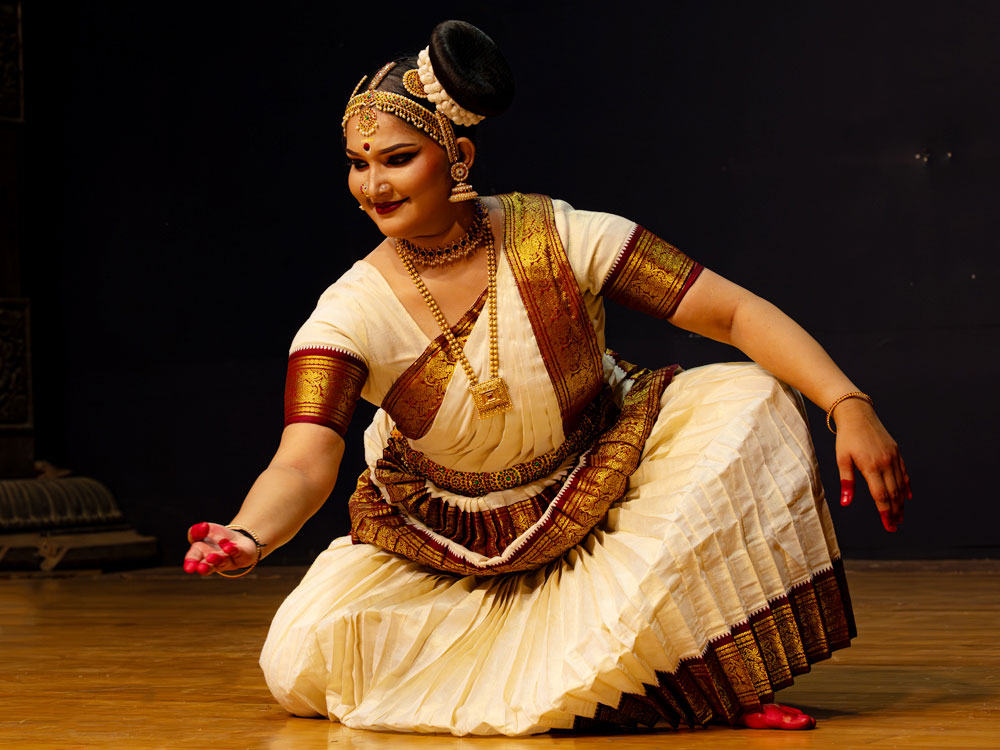
Mohiniyattam

From the cultural renaissance in the 19th-century court of Travancore’s ruler, Swathi Thirunal developed Mohiniyattam, sculpted into Kerala’s most graceful expression of feminine devotion. It was traditionally performed by women costumed with the gold-rimmed white of Kerala’s kasavu, whose slow, sweeping movements narrate tales of love and longing. But foreign eyes failed to grasp its dignity. Under colonial scrutiny, Mohiniyattam was misread as seduction; its dancers were unfairly cast in shame, and the form teetered on the edge of disappearance.

When Kerala Kalamandalam was founded, reviving Mohiniyattam became one of its most tasked challenges. The revival began in 1950 when Thottassery Chinnammuamma agreed to teach at the institution. From there, a quiet restoration unfolded, with artists like Kalamandalam Satyabhama shaping its expression and scholars like Kilimangalam Vasudevan Nambudiripad anchoring it in tradition. In time, Mohiniyattam reclaimed its place as one of India’s most revered solo dance traditions.

Thullal

In a time when performances were bound by classical codes and reluctant to step beyond the traditions of a stage, a lone voice broke through with humour, courage, and wild originality. That voice belonged ....

MORE

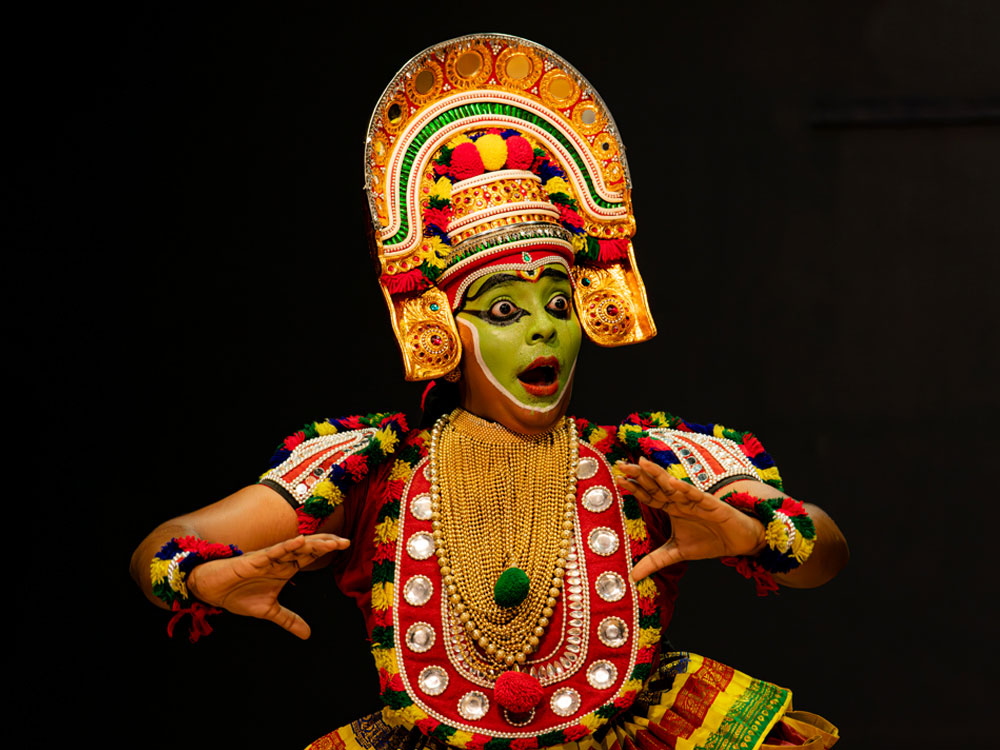
Thullal

In a time when performances were bound by classical codes and reluctant to step beyond the traditions of a stage, a lone voice broke through with humour, courage, and wild originality. That voice belonged to Kunchan Nambiar, the 18th-century poet-performer who turned humour into a weapon to challenge the absurdities of society. What he created was Thullal, Kerala’s most radical performance form, a biting solo act that made people laugh, think, and question long before stand-up comedy had a name.

Choosing the language of the people, Malayalam, over the grandeur of Sanskritised Manipravalam, Nambiar broke linguistic hierarchies and composed a repertoire of over forty plays that resonated with everyday audiences. What gave Thullal its lasting influence was its unique, interactive style carried through fast-paced footwork, expressive movements, and the steady pulse of percussion that kept the audience engaged. By bringing performance down from its lofty pedestal and placing it among the people, Thullal became a form far more popular than many of the temple arts of its time. Once confined to men, Thullal began expanding its horizons when Kerala Kalamandalam opened its doors to female students in 1960, embracing a more inclusive future for Thullal.

Scroll